Today’s Sponsor
Tax season quietly reshapes where capital flows — refunds hit accounts, portfolios get rebalanced, and positions get liquidated to cover obligations. That creates unusual early movement in small-cap stocks that has nothing to do with company fundamentals. Right now, certain names are already showing structural signals most investors will miss entirely.
We've put together a free Market Structure Guide breaking down how tax season shifts market activity, why some small-cap profiles move unexpectedly in March and April, and three companies already showing early breakout signals. The window to act before broader attention arrives is narrow — don't wait.
Get the Free Market Structure Guide*We encourage readers to perform their own research and due diligence on any information we provide. By clicking the link you will automatically be subscribed to the Fierce Investor Newsletter. Privacy Policy

Friday, June 5, 2026: Labor prints hot enough to keep rate-cut dreams on a leash. Semis lose altitude. DC can’t even extend surveillance cleanly. Middle East risk premium tries to re-price itself.
Image via AP News
Israel Hits Southern Lebanon After Evac Warnings — Energy Risk Premium Tries To Wake Up
Israel struck targets in southern Lebanon after issuing evacuation warnings to several villages, signaling the north front is still live even as markets have been treating it like background noise.
This matters because the risk isn’t just “headlines.” It’s miscalculation risk: a localized exchange that suddenly drags in wider actors, forces shipping/insurance repricing, and nudges crude and defense demand higher while pressuring regional assets.
Gold and oil don’t need a full-blown regional war to move. They just need traders to stop selling the optionality.
📈 Fred's Take: Geopolitical risk has been priced like a rounding error. That works until it doesn’t—then oil gaps, airlines eat it, and defensives outperform in a hurry. If this escalates, expect a bid in crude/energy equities and defense, plus a floor under gold; if it fades, the market goes right back to obsessing over rates and semis.
📎 AP News
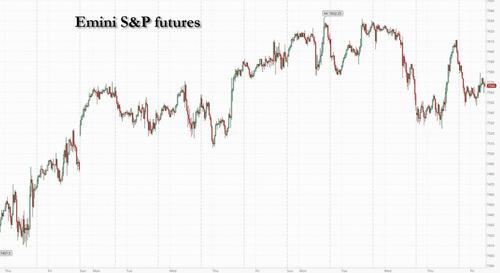
Image via ZeroHedge
Futures Slip As Chips Sour, Korea Gets Hit — This Is How Risk-Off Starts
Futures are lower with tech under pressure, and South Korea’s Kospi is sliding—classic early warning when the market’s leadership trade starts to wobble.
When semis lose sponsorship, it’s not just one sector. It’s the entire “AI duration” complex: high-multiple software, levered growth, and anyone funding buybacks with optimism. Korea’s tape matters because it’s a real-time stress gauge for global chip supply chain sentiment.
If premarket weakness holds, you’ll see the usual rotation: megacap defends, cyclicals sag, and vol gets bid.
📈 Fred's Take: Watch semis like you watch credit spreads—leadership cracks first. If chips can’t bounce, the S&P’s downside gets air pockets because passive flows won’t save you when the generals are bleeding. In that regime, tighten risk, respect stops, and don’t confuse a one-day dip with “value” when multiples are still pricing perfection.

Image via TheStreet
Broadcom Sells Off After ‘Fine’ Earnings — Wall Street Wants AI Fireworks, Not Competence
Broadcom shares dumped hard after earnings that were basically in line, but not loud enough on the AI acceleration narrative. Citi revisited its target after the post-print drawdown, highlighting the gap between operational execution and market expectation.
This is the 2026 tape: “good” is a miss if the AI slope doesn’t steepen in the press release. With semis priced as the toll collectors of the next capex cycle, any hint of normalization gets punished fast.
The selloff also spills into the broader complex because AVGO is a sentiment stock now, not just a cash-flow stock.
📈 Fred's Take: The market is telling you the bar is too high—when in-line numbers trigger a double-digit wipeout, the multiple is doing the fragile work. If you’re long semis, you need to underwrite volatility and time horizon, not just fundamentals. AVGO can still be a great business and a bad stock for a quarter if AI revenue optics don’t re-accelerate.

Image via The Hill
FISA Extension Hits Resistance — Six GOP ‘No’ Votes Turn Surveillance Into A Market Headache
Six Republican senators joined Democrats to vote against advancing a FISA extension, complicating the push to keep warrantless surveillance authorities from expiring next week.
Washington is good at one thing: turning routine governance into a binary event. If this slips into a lapse or a last-minute patchwork, expect a familiar cocktail—process risk, headline volatility, and more distrust between party factions.
This doesn’t hit earnings today, but it feeds the broader theme: institutions don’t love investing into a government that can’t pass “must-pass” items cleanly.
📈 Fred's Take: This is another reminder that political dysfunction is becoming a macro variable, not theater. It won’t tank the S&P by itself, but it adds noise premium—higher implied vol, more event hedging, and less appetite for long-duration bets when policy execution looks shaky. The market trades confidence; DC keeps shorting it.
📎 The Hill
Image via Fox Business
May Jobs: +172K, Unemployment 4.3% — Fed Cut Traders Just Got A Reality Check
The U.S. added 172,000 jobs in May, well ahead of expectations, with unemployment holding at 4.3%. That’s not a reacceleration boom, but it’s a clean “still growing” signal.
For markets, the implication is straightforward: the Fed doesn’t have to hurry. A labor market that’s bending but not breaking keeps real rates sticky, keeps the front end sensitive, and makes “multiple expansion” harder for growth stocks.
Rates will do the talking today—watch the 2-year, then watch how semis and high-multiple tech react.
📈 Fred's Take: This print keeps the soft-landing narrative alive but delays the easy-money fantasy. Stronger jobs = fewer cuts priced = tighter financial conditions than the bulls want. Translation: equities can still grind higher, but the path is narrower—quality cash flows over story stocks, and don’t fight the rate tape.
That’s the map before the bell: jobs says ‘not yet’ on cuts, chips say ‘prove it,’ DC says ‘can’t govern,’ and the Levant says ‘don’t ignore risk.’ Trade accordingly.
— Fred Frost
