Today’s Sponsor
It's not gas, groceries, or Medicare premiums. The fastest-rising cost quietly draining American retirees is housing — and Social Security's COLA isn't keeping up. The 2027 adjustment is projected at just 3.9% ($81/month), while rent, property taxes, insurance, and maintenance have surged by hundreds in just two years. Even if your home is paid off, you're still getting squeezed. The Senior Citizens League confirms it: every dollar of Social Security today is worth only 86.3 cents compared to 2016.
Central banks have already responded — buying one specific asset at the fastest pace in 50 years, with JP Morgan forecasting it hits $8,000. Disciplined retirees are making the same move now to protect what they've saved. You're making a decision today whether you realize it or not. Don't leave it to chance.
Get the Free Wealth Preservation GuideThis is an advertisement. If you no longer wish to receive our promotions, please unsubscribe here. Or write to: 5005 Lyndon B. Johnson Fwy. Suite 350, Dallas, TX 75244.

Politics is trying to spend, police, and redraw the map. Markets are trying to price growth that still won’t quit. Here’s the money trail before the bell.
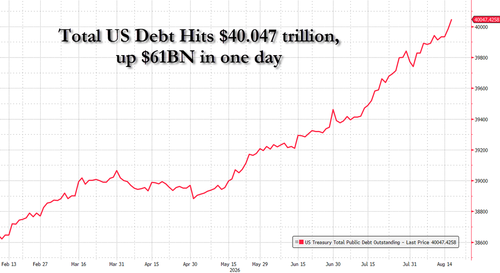
Image via ZeroHedge
Trump Teases $5,000 Checks: The New Bull Case for Higher Yields
Trump floated $5,000 "stimmy" checks for every adult citizen if Republicans hold Congress. It’s a clean headline, a simple promise, and the kind of fiscal signal markets don’t ignore.
Do the math and you’re staring at another big deficit impulse. Even if it’s just a trial balloon, it shifts the negotiating center: more cash out the door, more Treasury issuance, and more pressure on the Fed to keep its inflation credibility intact.
If this idea gains traction, expect the usual sector tells. Consumer discretionary loves the sugar high, but rate-sensitive growth and housing don’t. The bond market will front-run it long before C-SPAN does.
📈 Fred's Take: This is bearish duration, full stop. If Washington starts campaigning on cash drops again, the long end sells first and asks questions later, and equities get forced into a "nominal growth vs. real discount rate" cage match. Play it as steeper curves, firmer inflation breakevens, and a higher bar for unprofitable tech.

Image via ABC News
Jobless Claims at 206,000: The Labor Market Won’t Crack on Schedule
Initial jobless claims dipped to 206,000, keeping layoffs rare and the headline number historically tight. That’s the simplest read: the engine is still running.
For markets, this matters less as a feel-good stat and more as a policy trap. A labor market that refuses to loosen keeps wage pressure alive and gives the Fed cover to stay restrictive longer than equity bulls want.
It also keeps the “soft landing” narrative in play, which is why dips keep getting bought. But the longer this stays hot, the more the risk migrates from recession to re-acceleration in inflation and a renewed rates tantrum.
📈 Fred's Take: Strong claims data is good news for earnings but bad news for multiples. If you want to be long equities here, you want quality cash flow and pricing power, not hope-and-dreams duration. The bond rally crowd keeps betting on cracks that aren’t showing up.
📎 ABC News
ICE at Polling Sites? Lawsuit Signals Election Risk Premium Is Coming Back
A coalition of advocacy groups and a Democratic-led city filed a preemptive lawsuit to block the Trump administration from deploying armed ICE agents and other federal agents to polling sites. The argument is straightforward: intimidation risk and chilling voter participation.
Markets don’t price civic vibes; they price uncertainty, delays, and institutional stress. If this escalates, you’re looking at headlines that extend the election calendar, increase the odds of court fights, and widen the distribution of policy outcomes.
The near-term impact shows up first in volatility, not fundamentals. Think higher demand for hedges, wider credit spreads at the margin, and a bid for liquid defensives when the tape gets noisy.
📈 Fred's Take: This is volatility-positive and risk-premium-positive, especially if it turns into a multi-state legal brawl. I’d expect VIX to stop behaving like a dead asset and start responding to politics again. Keep some convexity in the book; it’s cheap until it isn’t.
📎 CBS News

Image via Roll Call
Trump Census Overhaul: Redistricting Is a Market Event Now
The Trump administration is proposing a census overhaul that could reshape congressional representation. Census mechanics sound boring until you realize they determine political power for a decade.
If the rules change, the map changes, and the policy path changes. That feeds directly into tax odds, regulatory odds, spending odds, and the probability of unified government versus gridlock.
Markets hate uncertainty but love constraints. A census fight is both: it injects legal and administrative noise now, while potentially hardening partisan advantage later. Investors should treat it like a slow-moving catalyst with sudden headline spikes.
📈 Fred's Take: This is a long-duration political trade: it matters more for 2028–2036 policy than tomorrow’s CPI print, but the volatility can hit anytime lawsuits and injunctions drop. Start thinking in scenarios: gridlock supports risk assets; sweeping control supports big fiscal and big regulatory swings. Don’t ignore it just because it’s procedural.
Germany Flickers Back to Life—But the AfD Is the Tail Risk
Germany is showing signs of economic life, but the recovery is fragile. The question hanging over it is political: can growth outrun the AfD’s momentum.
For markets, Germany is the hinge for Europe’s industrial cycle and the credibility anchor for EU fiscal choices. If the recovery firms, European equities and the euro get a cleaner runway, and the ECB can stay patient without looking complacent.
If politics destabilize the coalition math, risk hits first in spreads. Watch BTP-Bund, bank equities, and the euro’s reaction function: Europe doesn’t need a recession to reprice; it just needs a governance wobble.
📈 Fred's Take: Europe’s trade is still a spread trade: stable Germany tightens risk, messy politics widens it. If German growth holds, I like selective European cyclicals and a less-bearish view on the euro; if AfD pressure accelerates, you rotate to defensives and treat rallies as sellable. Political drift in Europe always shows up in credit before it shows up in GDP.
Trade the facts, hedge the headlines. See you before the bell.
— Fred Frost
