Today’s Sponsor
Nuclear energy isn't waiting around — and neither should you. Last year, nuclear-related stocks surged 40%+, driven by real earnings, real contracts, and real demand. One uranium producer alone generated nearly $200 million in quarterly free cash flow, while others locked in long-term government contracts — no commodity swings required. With U.S. nuclear capacity projected to triple over the coming decades, this buildout is just getting started.
MarketBeat analysts have identified 7 top nuclear stocks positioned to ride this wave — some with upside tied to uranium prices, others backed by steady contracts and infrastructure spending. The full report is free right now, but it won't stay that way. Grab your copy before it moves behind the paywall.
Send My Free Nuclear ReportBy clicking the link above, you will receive this free report and a free subscription to MarketBeat's daily email newsletter. You are also agreeing to the terms of our privacy policy. Unsubscribe at any time.

Monday, September 14, 2026. Politics is price. Energy supply breaks, AI fences go up, war risk leaks into Europe, healthcare plays defense, and logistics reminders hit emerging markets.
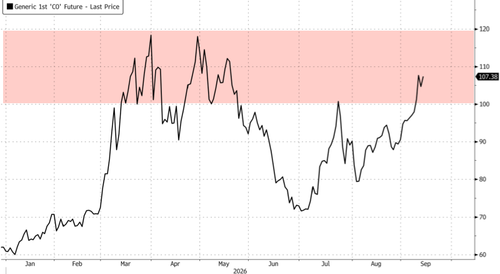
Image via ZeroHedge
Saudi Pipeline Shock: Markets Smell $150 Oil
Brent popped overnight after Saudi Arabia shut the East-West pipeline amid a crisis that puts roughly 4% of global supply in play. When the Kingdom turns a valve, the whole complex reprices: crude, refined products, shipping, inflation expectations, and eventually rates.
This is the worst kind of energy headline for risk assets because it hits both growth and inflation at the same time. If it lasts more than a couple sessions, you get margin pressure on consumers, airlines, chemicals, and anything that relies on cheap freight. And you hand central banks a fresh excuse to stay tight even if the economy is rolling over.
📈 Fred's Take: This is a volatility event first and a macro event second. If the pipeline disruption drags, energy equities and oil-linked credit outperform while broad equities eat multiple compression as inflation breakevens lift. Base case: crude mean-reverts if barrels get rerouted, but the tail is ugly and markets will price it quickly—own energy as insurance, and don’t chase long-duration growth into an oil spike.

Image via ABC News
China to Anthropic: Hands Off Our AI
Beijing publicly swatted back at Anthropic’s CEO after he urged the U.S. to curb China’s AI development. China’s message is simple: they see AI as strategic infrastructure, not a consumer app category. And they’re not asking permission.
This matters because the AI trade is now explicitly geopolitical. Export controls, model restrictions, chip bans, and compute access are no longer “policy risk” in the footnotes—they’re the product roadmap. Every new statement hardens the split between U.S.-aligned and China-aligned AI stacks.
📈 Fred's Take: Markets will keep mispricing this as a headline cycle until earnings force the issue. The winners are the firms that can sell “sovereign AI” picks-and-shovels to both blocs without tripping sanctions; the losers are the ones whose growth assumes a single global platform. If you own AI beta, you’re also long geopolitics—size it like a political position, not a software subscription story.
📎 ABC News

Image via France 24
453 Drones, One Near Poland: War Risk Presses Europe’s Edge
Russia hit Ukraine with a massive overnight drone barrage, and one strike reportedly landed within 800 meters of a border crossing with Poland. Poland is calling it escalation. That’s not just rhetoric—border proximity is where accidents become Article 4 meetings and where markets start pricing real spillover risk.
Europe’s risk premium doesn’t need a formal expansion of the conflict to widen. It just needs uncertainty around infrastructure, transport routes, and the probability of miscalculation. Energy and defense immediately catch a bid; European cyclicals don’t.
📈 Fred's Take: The market reaction function is asymmetrical: calm days do nothing, but near-border incidents reprice fast. If this trend persists, expect a heavier European defense capex narrative, higher regional volatility, and a firmer USD vs EUR on risk-off days. For portfolios, keep Europe exposure paired with defense/energy hedges or keep it small—this tape punishes unhedged optimism.
Novo Drops “Nordisk” in a Reboot Move
Novo is reportedly ditching “Nordisk” from its name as it tries to revive the brand and sharpen the story. Name changes are rarely cosmetic at this scale—they’re usually a signal that management wants the market to re-underwrite the business, the pipeline, and the post-boom growth path.
Big pharma is in a weird moment: investors want durable cash flows, but they pay up for category dominance. If leadership thinks the old identity is tethered to the last cycle, they’ll try to reset expectations with a cleaner, broader label and a refreshed narrative around innovation.
📈 Fred's Take: Rebrands don’t fix fundamentals, but they can be the first step in a strategic pivot: portfolio reshuffle, bolt-on deals, and a new capital return cadence. Watch for what follows—guidance posture, R&D prioritization, and any M&A tells—because that’s what moves the multiple. If you’re long healthcare as a defensive growth sleeve, you want clarity on earnings durability more than a new logo.

Image via NTD (via Reuters)
Indonesia Ship Capsize: Tragedy, Then a Logistics Reality Check
Search operations are underway after an Indonesian passenger ship capsized, according to BASARNAS via Reuters reporting carried by NTD. Human cost first, always. But markets also absorb these events through a cold lens: transport safety, regulatory enforcement, and the fragility of maritime movement in archipelagic economies.
Indonesia sits on critical trade routes and is deeply exposed to shipping reliability—from local mobility to commodity logistics. Disruptions and safety scrutiny can raise operating costs, delay flows, and trigger tougher compliance requirements across operators.
📈 Fred's Take: This won’t move global markets by itself, but it’s a reminder that “emerging market growth” includes infrastructure and safety risk that doesn’t show up in models until it hits headlines. For investors, the takeaway is simple: price a higher operational risk premium in transport-linked names and don’t assume seamless logistics in the supply chain narrative. When costs rise quietly, margins don’t.
That’s the tape: oil risk is back, AI is officially a border dispute, Europe’s edge is getting sharper, healthcare is repositioning, and logistics risk is never asleep. Trade accordingly.
— Fred Frost
