Today’s Sponsor
Nuclear energy stocks surged 40%+ this year as the next buildout cycle accelerates toward 2026. One uranium producer just generated nearly $200 million in quarterly free cash flow, while other nuclear companies locked in massive government contracts—all driven by real earnings and exploding demand as U.S. capacity is projected to triple.
Our analysts identified 7 nuclear stocks positioned to capitalize on this trend right now. Some offer explosive upside tied to uranium prices, others provide steady growth from infrastructure contracts. Get the complete list with names and tickers free today—but this report moves behind the paywall soon.
Get the Free ReportBy clicking the link above, you will get this free report and a free subscription to MarketBeat's daily email newsletter. You are also agreeing to the terms of our privacy policy. Unsubscribe at any time.

Morning Bullets — Tuesday, July 14, 2026

Image via MarketWatch
Crude Jumps 8% as Straits Close and Pentagon Briefs Carriers
WTI and Brent both posted their biggest two-day rally since March, with front-month contracts climbing above $88 and $91 respectively. The move came as U.S. and Iranian forces exchanged fire in the Strait of Hormuz after Tehran announced it would inspect all tanker traffic. Pentagon confirmed two destroyers are now stationed in the strait with carrier support 200 miles out.
Energy names ripped higher in overnight trading. XLE up 4.2% pre-market, with majors like XOM and CVX each adding 5%. Tanker stocks went vertical — STNG, FRO, and TNK all up double digits as day rates for VLCCs reportedly tripled in 48 hours. Options flow showed massive call buying in energy services, particularly SLB and HAL.
The real tell: gold rallied alongside crude, both breaking key resistance. That's not an inflation trade. That's a war-premium trade. VIX touched 24 before settling at 22, and Treasury yields dropped 11 basis points as money flooded into duration. Classic flight-to-quality with an energy spike overlay.
📈 Fred's Take: If the strait stays hot for another 72 hours, you're looking at $95 crude and SPX 200 points lower. The White House has maybe a week before this becomes an economic problem, not just a military one. Energy is the only sector you want to be long right now, and I'd be buying puts on anything consumer discretionary that can't pass through fuel costs.

Image via The Hill
Graham Sanctions Bill Gets Fast-Track as Senate Plays Memorial Politics
Lindsey Graham's final legislative act might be his most consequential. The Russia sanctions package he authored before his death last month is getting rushed through both chambers as Democrats and Republicans compete to honor his legacy. The bill targets Russian energy exports, financial institutions, and includes secondary sanctions on any entity processing payments for Moscow.
The timing couldn't be worse for European energy markets. Germany and Italy have been quietly increasing Russian LNG imports over the past six months as Middle East tensions made alternatives expensive. If this passes with secondary sanctions intact, European nat gas futures are going to explode. We're already seeing TTF contracts in Amsterdam up 6% on the headline alone.
The real kicker: Graham's sister Darline just got appointed to finish his term, and her first vote will likely be on this bill. She's already signaled she'll support it. The political optics are overwhelming any policy debate. This thing passes by Friday.
📈 Fred's Take: Secondary sanctions mean U.S. energy exports to Europe are about to double, which is bullish for domestic LNG players and bearish for European industrials. Buy Cheniere Energy and short German manufacturing. This bill turns European energy dependence into an American profit center.
📎 The Hill

Image via Politico
Darline Graham Takes Senate Seat as GOP Primary Turns Into Thunderdome
South Carolina Governor appointed Lindsey Graham's sister as interim senator, a move that's pure political theater but creates a wide-open primary for 2027. Darline Graham is 68, never held office, and explicitly said she won't run for a full term. She's a placeholder, which means every ambitious Republican in the state just cleared their calendar.
The market angle: Graham chaired the Senate Appropriations Subcommittee on State and Foreign Operations, and sat on Armed Services. His death already created a vacuum on defense spending priorities. Now you've got 8-10 Republicans fighting over who inherits his hawkish foreign policy lane, which means defense spending bills are about to get very loud and very expensive.
The safe bet is that whoever wins Graham's seat will try to out-hawk everyone else on China, Russia, and Iran. That's bullish for defense primes — LMT, RTX, NOC, GD. The South Carolina primary becomes a proxy fight for the defense industrial base.
📈 Fred's Take: Defense contractors just got a two-year visibility boost. Graham's replacement will spend billions proving they're tough enough to fill his shoes. If you're not long defense going into 2027 appropriations, you're missing the setup.
📎 Politico
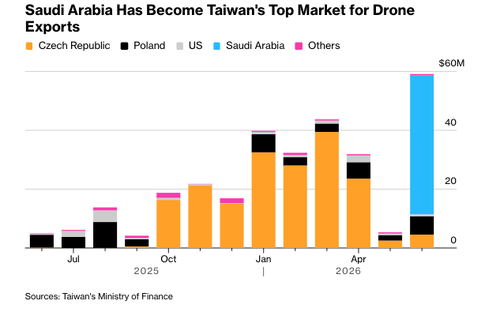
Image via ZeroHedge
Saudis Buy $47M in Taiwan Drones as Warfare Goes Asymmetric
Saudi Arabia just became Taiwan's largest drone customer, dropping $47.2 million on small unmanned systems in the last quarter. That's a 340% increase from 2025 and makes Taiwan the second-largest military drone exporter behind only Turkey. The Saudis are using these against Iranian proxies in Yemen and reportedly in the strait conflict.
This is the Iran war changing procurement doctrine in real time. Small, expendable, networked drones are proving more valuable than expensive manned aircraft for the kind of fighting happening in the Gulf right now. Taiwan's defense exporters — particularly smaller names that aren't household brands — are about to see order books explode.
The geopolitical subtext: Saudi reliance on Taiwan tech creates a weird strategic triangle with Beijing. China can't squeeze Taiwan militarily without threatening Saudi defense supply chains, which matters when oil is already spiking. Taiwan just turned its chip monopoly into a defense monopoly.
📈 Fred's Take: Taiwan defense stocks are uninvestable for most U.S. accounts, but this validates the thesis on autonomous systems globally. AeroVironment, Kratos Defense, and even some of the software plays like Palantir benefit as this procurement model spreads. The age of the $80 million fighter jet solving Middle East conflicts is over.
China Grabs U.S. Seismologist in Move That Targets Nuclear Intel
Beijing detained an American seismologist who spent the last decade studying North Korean nuclear tests through seismic data. Dr. Patricia Chen, a U.S. citizen and professor at Columbia, was taken into custody while attending a conference in Shenzhen. State Department confirmed her detention but won't comment on charges.
This isn't random. Chen's research involves detecting underground nuclear tests by analyzing seismic waves — the exact capability the U.S. uses to verify whether North Korea is cheating on any potential arms agreement. China grabbing her sends a signal that they're cutting off our visibility into Pyongyang's program. It also suggests China and North Korea are coordinating more closely than anyone in Washington wants to admit.
The market read: this raises the probability of North Korean nuclear escalation because our early warning system just got blindfolded. Gold popped another $12 on the news. Defense stocks ticked higher. Anything tied to Korean peninsula stability — Korean equities, regional trade plays — sold off.
📈 Fred's Take: When China starts detaining scientists, they're preparing the battlefield for something bigger. Stack this with the Iran situation and the Graham sanctions, and you've got three simultaneous escalation tracks. The only hedge is hard assets and defense. Everything else is hope.
📎 Reuters
Futures are ugly. Stay liquid. — Fred
— Fred Frost
