In partnership with

Attio is the #1 fastest-growing CRM on Brex and Ramp

Built for the most ambitious companies in GTM, Attio is an end to end revenue platform that allows teams to run multiple plays across different revenue motions and lifecycles.
Teams at the frontier are already building on it: Granola, turbopuffer, Modal, and many many more.

Tuesday tape: oil’s giving consumers a break, Washington’s chip rules keep biting, Beijing pauses the minerals squeeze, U.S. infrastructure shows its age, and a data-center supplier learns what “good numbers” means in a crowded trade.

Image via Axios
Oil Drifts Lower, Gasoline Follows
Brent starting the week below $90 and tagging the lowest levels since late August is doing what it always does with a lag: dragging gasoline down. This is the cleanest disinflation channel left that shows up fast in real life, not just in spreadsheets.
Lower pump prices don’t just help consumers. They loosen financial conditions at the margin: fewer dollars burned at the station, fewer political pressure valves popping, and less urgency for the Fed to keep talking tough just to protect “credibility.”
📈 Fred's Take: This is a stealth tailwind for risk assets into year-end: softer headline CPI prints, better consumer mood, and less policy risk around “emergency” energy narratives. Don’t overtrade it in the oils though. If crude is sliding on demand anxiety rather than supply relief, cyclicals feel it next. Long consumer, neutral energy beta, and keep an eye on breakevens for the real signal.
📎 Axios
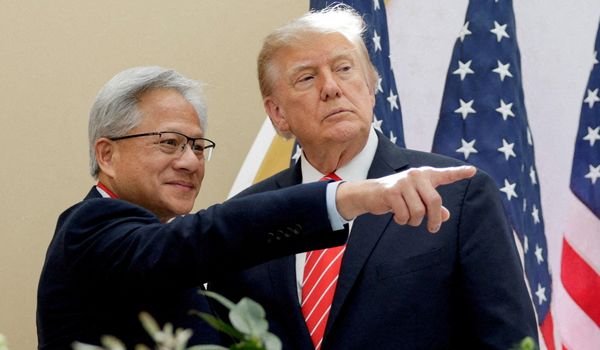
Image via National Review
Huang’s Return Isn’t a Get-Out-of-Control-Free Card
Jensen Huang popping back into the spotlight doesn’t change the core issue: Nvidia’s growth path is now tethered to U.S. export controls and the political calendar. Washington has decided advanced compute is a strategic asset, and the rules will keep moving.
Investors want a simple story: AI demand up and to the right, margins intact, buy every dip. The problem is the U.S. can throttle China exposure with a pen stroke, and every workaround invites the next restriction. That’s not a business model you can value with last year’s multiple.
📈 Fred's Take: Nvidia can be a great company and a frustrating stock at the same time. The market will keep paying for growth, but it will discount geopolitical optionality hard when headlines hit. If you’re long, size it like a political risk position: great upside, but expect sudden air pockets and don’t pretend policy is “noise.”

Image via ZeroHedge
Beijing Pauses the Minerals Hammer to Keep the Truce Alive
China extending the suspension of its export ban on key critical minerals is a tell. They want to avoid a fresh U.S. escalation and keep the trade truce from cracking, especially when global demand signals are mixed and domestic pressures are real.
Gallium and germanium aren’t dinner-table words, but they sit inside defense, chips, optics, and industrial supply chains. The mere threat of restrictions forces inventory hoarding, price spikes, and capex reshuffles. A pause reduces the near-term shock risk.
📈 Fred's Take: This is Beijing choosing macro stability over leverage, for now. Markets should read it as a de-escalation impulse, which helps semis and industrials breathe, but don’t confuse “pause” with “peace.” If you’re allocating to materials or defense supply chains, the play is resilience: diversified sourcing and selective exposure to non-China producers, not chasing a one-week price dip.

Image via RealClearMarkets
Air Traffic Control Is Aging Out, and the Market Will Price the Fix
Another communications failure stranding travelers is the predictable outcome of running critical national infrastructure on tech with roots in the 1960s. Aviation is a high-throughput, low-tolerance system. When it breaks, the economic cost isn’t theoretical; it hits labor hours, commerce, and confidence immediately.
This isn’t just an FAA story. It’s a capex story, a procurement story, and a “who gets the contract” story. Modernization will happen because it has to, and it will be expensive because it’s late.
📈 Fred's Take: The investable angle is straightforward: forced upgrade cycles create multi-year demand for communications hardware, cybersecurity, and systems integration. The risk is execution and politics: delays, cost overruns, and ugly headlines that hit contractors. Own the picks-and-shovels with recurring revenue where possible, and avoid the single-project heroes.

Image via Benzinga
Semtech Beats, Stock Drops: Welcome to the New Standard
Semtech beating expectations and still getting hit hard premarket is the tape reminding everyone of the current regime: results aren’t enough, guidance and narrative are everything. In a market crowded into anything “data center,” investors demand acceleration, not adequacy.
The bull case being pitched is a billion-dollar data center opportunity. Fine. But the market is also asking how fast that ramps, what margins look like in a competitive supply chain, and whether demand is real pull-through or just customers testing and sampling.
📈 Fred's Take: A beat with a selloff usually means positioning was rich and the forward path wasn’t clean. Don’t fight that tape on day one. If you like the data-center angle, wait for price to stabilize and look for confirmation in orders and gross margin trajectory, not a one-quarter headline. This is a stock you trade around levels until the ramp proves itself.
📎 Benzinga
That’s the morning setup. Trade the facts, price the politics, and don’t pay peak multiples for policy risk.
— Fred Frost

