In partnership with

The ice cream shop that makes money when it's cold

28 Wishes sells ice cream in Los Angeles. Below 70°F, sales fall about 20%. The weather is out of their hands. Rent isn't.
So the owners started putting about $20 a day into Kalshi weather markets, taking the cold side. The days that keep customers away now pay something back.
This is hedging. Big companies have done it for decades, buying protection against bad weather, fuel spikes and rising rates. It used to take a broker, a trading desk, and an order size no corner shop could meet.
Kalshi opens it up. Contracts on weather, fuel prices, inflation, tariffs and regulation, starting at a few dollars. Take a position on the outcome that would hurt you. If it hits, the payout softens it. If it doesn't, the contract expires and the good month was the point.

Politics is campaigning on prices while markets are trading on scarcity: gas in Europe, capital for AI, and tax optics for 2028.

Image via NBC News
Michigan Senate debate turns into an inflation blame game
Abdul El-Sayed and Mike Rogers spent the final Michigan Senate debate doing what candidates do when grocery bills are still high: point at each other and talk past the math. El-Sayed leaned into household costs and protection narratives. Rogers went after spending and competence, framing affordability as a government-created problem.
For markets, Michigan matters less for ideology and more for margins. Cost-of-living politics usually ends in one place: more subsidies, more targeted tax credits, more regulatory pressure on “price gouging,” and more noise around healthcare and energy pricing. That’s a cocktail that raises policy uncertainty without actually lowering CPI.
The “final sprint” tone also tells you campaigns think turnout will be tight. Tight races pull candidates toward populist promises, and populist promises tend to become budget items.
📈 Fred's Take: Inflation politics is back because inflation pain is still back. If Dems win close states by running on affordability, expect more fiscal patchwork that props up demand at the margin and keeps the Fed boxed in. If GOP candidates win by running against spending, you still don’t get austerity; you get different deficits. Either way, duration stays a trade, not an investment.
📎 NBC News
Palantir shows up in Brussels as Europe tries to de-risk US tech
Palantir’s Mosley in Brussels is the tell: Europe wants digital sovereignty, but the stack still runs on American code. The EU can regulate and fine; it can’t instantly rebuild cloud, AI tooling, and defense-grade data platforms without paying a growth tax.
This is the same old European playbook with a sharper edge: push procurement rules, data residency, interoperability mandates, and “strategic autonomy” language that quietly steers contracts toward EU champions. The US firms keep the performance advantage, but they may have to share economics, localize more infrastructure, and accept slower deployment cycles.
The market angle is bifurcation. If Brussels forces fragmentation, winners are the firms that can operate in multiple regulatory regimes without breaking product velocity. Losers are the ones that need one global platform to make the unit economics work.
📈 Fred's Take: Regulatory friction is a tax on growth, and Europe is writing the invoice. Palantir benefits near-term because governments don’t experiment when security is the mandate, but the longer-term risk is margin dilution via localization and procurement politics. Watch for “EU-first” frameworks that look like compliance and act like protectionism. This is bullish for cybersecurity and sovereign cloud capex; it’s not uniformly bullish for Big Tech multiples.
Jensen says neocloud demand is exploding; capital says “not at these terms”
Nvidia’s Jensen Huang says neocloud demand is “off the charts,” but the constraint is capital. Translation: customers want GPU time yesterday, but the financing stack for new AI infrastructure is tighter than the hype cycle admits.
Neoclouds are capex monsters. They need chips, networking, power, real estate, and long-term energy contracts, then they need customers who won’t churn the moment pricing normalizes. With capital scarce, the build-out slows, which keeps GPU scarcity alive, which keeps pricing power elevated across the AI supply chain.
This is also a rates story. Expensive money doesn’t kill AI demand; it changes who gets to meet it. The winners are the firms with balance sheets, pre-sold capacity, and access to cheap power. Everyone else becomes a customer, not a competitor.
📈 Fred's Take: The next leg of AI is a credit allocation story, not a chip story. Scarce capital means fewer neocloud survivors, more consolidation, and more durable pricing power for incumbents that can finance at scale. Nvidia stays in the pole position, but the real trade is downstream: power, cooling, and data-center REIT economics where contracts are long and financing is everything. If you’re betting on “AI for everyone,” you’re really betting on spreads coming in.
📎 CNBC
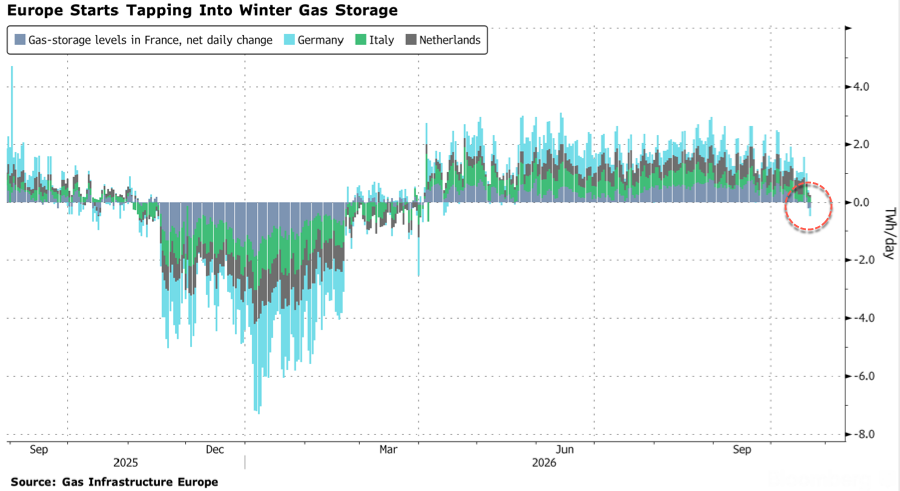
Image via ZeroHedge
Europe starts pulling gas from storage with reserves already thin
Europe is heading into withdrawal season with natural gas storage at a level that leaves no room for winter surprises. Futures ticking up early is the market doing what it always does when inventories are tight: pricing optionality and fear.
Low reserves don’t just mean higher utility bills. They mean higher volatility, political pressure for intervention, and a renewed subsidy reflex if prices spike. That feeds back into fiscal math, sovereign spreads, and the euro’s growth outlook, especially if industry curtails again.
Energy is still Europe’s macro Achilles heel. When the weather is your central bank, you don’t get stable forward guidance. You get headline inflation shocks, stop-start industrial output, and a policy mix that lags the tape.
📈 Fred's Take: Thin gas buffers are a volatility engine, not just an energy headline. If winter is normal-to-cold, expect renewed inflation prints and a less dovish ECB than equity bulls want, even if growth stinks. That’s bearish Europe cyclical equities, supportive for gas-linked exposures, and quietly constructive for USD vs EUR on relative energy risk. Europe can talk sovereignty all day; it still trades molecules.

Image via RealClearMarkets
Newsom’s California tax “gift” is a 2028 liability, not a flex
A RealClearMarkets piece frames Gavin Newsom’s $14.3B tax “gift” as the kind of California politics that plays well in-state and poorly on a national stage. The critique is familiar: high taxes, low affordability, visible dysfunction, and the pitch that more of it should be federal policy.
Investors should read this less as a Newsom profile and more as a preview of the policy branding war coming. If Newsom runs, his lane is redistribution wrapped in competence theater. Opponents will brand him as the embodiment of high-cost governance. Markets trade the probabilities of each story, not the slogans.
California is also a bond-market state. When fiscal gestures collide with outmigration narratives and big spending obligations, the muni buyer demands clarity. The moment “gift” becomes “gap,” spreads do the talking.
📈 Fred's Take: National ambitions don’t change the math: high-cost states can’t run on vibes when rates aren’t free. If Newsom becomes a real White House contender, markets will immediately handicap higher federal tax and regulatory risk, even if the policy never materializes. The trade is not partisan; it’s exposure management: be careful with tax-sensitive sectors and any business model that needs California-style governance scaled nationwide. Politics sells stories, but bond markets invoice outcomes.
Trade the constraints: capital, energy, and policy. Everything else is commentary.
— Fred Frost
