Today’s Sponsor
The Fed held rates, CPI came in at 2.4%, and analysts still expect 12.5% Q1 earnings growth — but estimates have already been cut across nine sectors and the S&P 500 is stretched above its 5- and 10-year average forward P/E. Trading earnings on headlines alone in this environment is a costly mistake.
The free Earnings Season eBook breaks down the exact pre-report checklist, how to weigh guidance and expectations, and how to read the first reaction after numbers hit — so you're never improvising after the move already started.
Get the Free Earnings PlaybookBy clicking the link above, you will receive this free report and a free subscription to the StockEarnings daily email newsletter. You are also agreeing to the terms of our Privacy Policy. Unsubscribe at any time.

Friday, August 28, 2026. Politics keeps rewriting risk premia. Markets keep repricing the map.

Image via NBC News
Nepal Floods Turn a Pilgrimage Route Into a Mass-Rescue Crisis
A catastrophic flood along the Nepal-Tibet border has left hundreds missing. Families are stuck in the worst kind of limbo: no confirmations, no reliable lists, and brutal terrain that turns search-and-rescue into a logistics war.
NBC reports 65 Americans are among the missing, including a New York couple traveling to Mount Kailash. This is the part markets ignore until it hits supply chains, insurance losses, airlines, and emerging-market risk premia.
The immediate story is human tragedy. The second-order story is infrastructure fragility in mountainous corridors that sit near sensitive borders and critical transit routes. When weather extremes turn into recurring events, the “once-in-a-century” actuarial tables get thrown in the trash.
📈 Fred's Take: Natural disasters don’t move the S&P on headline, but they do move pricing power and costs over time. Expect more capex toward hardening infrastructure and more pressure on insurers and reinsurers as climate volatility keeps upgrading from tail-risk to baseline. In portfolios, that means don’t hand-wave catastrophe risk: it shows up as higher premiums, tighter underwriting, and higher discount rates for long-duration assets.
📎 NBC News
Iran Wants a Global Front Against U.S. Sanctions — Energy Traders Hear “Higher Risk Premium”
Iran is calling for global pushback against U.S. sanctions while signaling diplomacy “isn’t impossible,” per CNBC. Their message ties the Gaza war, Israel’s posture in Lebanon, and strikes in Syria into one package: de-escalate the region, and the economic pressure campaign should ease.
Markets don’t trade speeches; they trade shipping lanes, insurance rates, and the probability tree around Hormuz. Every time Tehran frames sanctions as illegitimate and asks the world to resist, it’s a reminder that the enforcement game isn’t just Washington versus Iran — it’s Washington versus everyone’s appetite for cheap barrels.
If diplomacy reopens even a crack, crude volatility compresses. If it doesn’t, the risk premium stays sticky, and that bleeds into inflation expectations, term premium, and ultimately equity multiples.
📈 Fred's Take: Treat this as an options market, not a moral debate. The base case is still elevated Middle East risk premium, which means crude stays jumpy and rates stay less friendly than the growth crowd wants. If you’re long duration tech, your real hedge isn’t a think-piece — it’s owning some inflation insurance: energy exposure, quality value cash flows, and a little gold as geopolitical convexity.
📎 CNBC

Image via The Hill
U.S. Shoots Down Cartel Drones With a Laser — Welcome to the New Border Tech Trade
The U.S. military used a high-energy laser to take down three drones near the southern border that officials linked to Mexican drug cartels, according to The Hill. That’s not sci-fi. That’s operational counter-UAS moving from PowerPoint to the field.
Cartels using drones isn’t new. What’s new is the escalation ladder: once drones become routine for surveillance and delivery, the response becomes a procurement pipeline. Lasers, jammers, radar, sensors, command-and-control software — the whole stack.
This is also a politics accelerant. Border security is already a campaign accelerant; add “weaponized drones” and Congress finds money fast, often with fewer questions and more urgency.
📈 Fred's Take: This is bullish for the defense-tech supply chain, full stop. Counter-drone becomes a recurring revenue category: upgrades, training, maintenance, and rapid iteration. Investors should stop thinking of “defense” as just primes and start mapping the picks-and-shovels: sensors, power management, rugged compute, and secure networking — the stuff that scales when threats scale.
📎 The Hill
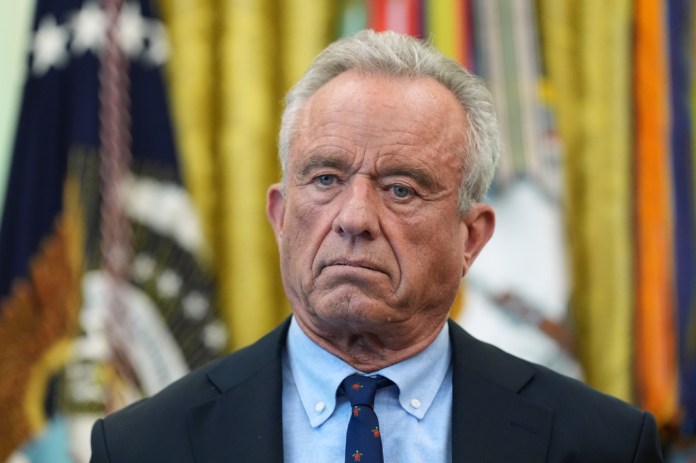
Image via Washington Examiner
RFK Jr. Under Fire — HHS Chaos Is a Quiet Tax on Healthcare Risk Assets
Democratic senators are calling for an investigation into Health and Human Services Secretary Robert F. Kennedy Jr. after reports he lied in his confirmation hearing, per the Washington Examiner. The accusation is straightforward: false statements to Congress, and lawmakers want accountability.
HHS is not a ceremonial job. It touches Medicare and Medicaid reimbursement, drug regulation, public health messaging, and the rule-making machine that can move billions in market cap with a memo.
Even if this doesn’t end in resignation, it increases the probability of policy paralysis, whiplash guidance, and a more adversarial posture between the agency and industry. Markets hate uncertainty, and healthcare is already a minefield of headline risk.
📈 Fred's Take: Healthcare investors should price a wider “Washington spread” until this is resolved. The winners are the businesses least dependent on discretionary regulatory favor: profitable medtech with diversified end markets, services that ride volume, and insurers with pricing discipline. The losers are anything that needs a clean, stable FDA and reimbursement cadence to hit forecasts — uncertainty is a valuation haircut.

Image via Yahoo Finance
Bank of America Doubles Down on Nvidia — The AI Trade Still Has Gravity
Bank of America is doubling down on Nvidia, according to Yahoo Finance. This is Wall Street doing what it does in momentum regimes: lean into the winner because the demand narrative still dominates the near-term tape.
Nvidia sits at the intersection of capex cycles, cloud buildouts, sovereign AI ambitions, and enterprise modernization. When a major bank reiterates conviction, it’s not just a call on one stock — it’s a signal that the Street believes the AI spending curve hasn’t rolled over yet.
The macro angle matters: if rates stay higher-for-longer, long-duration growth needs earnings delivery, not vibes. Nvidia’s role in the stack makes it a proxy for whether AI capex is real, persistent, and broadening beyond a handful of hyperscalers.
📈 Fred's Take: I’m not chasing this because an analyst pounded the table — I’m holding it if the capex data keeps confirming. The bull case is simple: AI is the new electricity buildout, and picks-and-shovels names keep printing. The bear case is also simple: if capex pauses, multiples compress fast — so size it like a volatility asset, not a bond substitute.
That’s the tape. Keep your risk tight, your thesis tighter, and don’t confuse headlines with exposures.
— Fred Frost

