Today’s Sponsor
One oil market disruption can trigger a chain reaction — tighter supply, shifting routes, and producers scrambling to adapt. Our research team has pinpointed 3 energy stocks uniquely positioned to benefit from this ripple effect, and each one has a distinct edge as the global energy landscape shifts.
These aren't just bets on higher oil prices. Inside Trading the Oil Supply Shock: Top 3 Energy Stocks Emerging From Global Supply Disruptions, we break down exactly what makes each company stand out — and why now could be the moment to pay attention.
Get the Free ReportBy clicking the link above, you're opting in to receive valuable updates from The Investor Newsletter Daily plus 2 bonus subscriptions. Your privacy is important to us. You can unsubscribe anytime. See our privacy policy for details.

Monday, October 12, 2026. Politics moved markets again: China intel risk goes domestic, Europe kneecaps hybrids, and Saudi airspace just got repriced in real time.

Image via NTD
California Spy Case Is The Tell: Washington’s China-Risk Premium Is Going Up
The FBI arrest in Los Angeles tied to alleged surveillance of Taiwan President Lai Ching-te’s family isn’t just a one-off counterintelligence headline. It’s a reminder that CCP-linked collection efforts aren’t confined to DC think tanks and defense contractors. They’re in communities, campuses, airports, and social networks where the targets move like civilians.
Politically, this hardens the bipartisan mood: more visa scrutiny, more restrictions on Chinese-linked entities, and more pressure on US firms to prove supply-chain and data cleanliness. Markets hear one thing: higher compliance cost, higher M&A friction, and more headline risk around anything that touches China money, China talent pipelines, or cross-border data.
📈 Fred's Take: This is another brick in the wall for US-China decoupling, and the tape will treat it that way. Expect a slow grind toward tighter rules on Chinese investment, research partnerships, and sensitive tech exposure. Translation for portfolios: defense-cyber stays structurally bid, China-adjacent US small caps stay structurally discounted, and any company still leaning on “China growth” gets a higher risk haircut.
📎 NTD
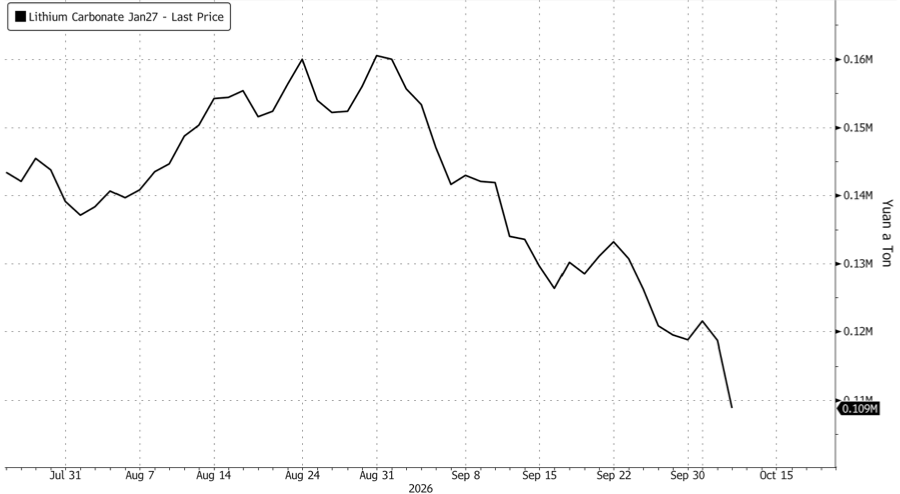
Image via ZeroHedge
Lithium Gets Smoked: Europe Just Put A Ceiling On The “EV-At-All-Costs” Trade
Chinese lithium futures dumped after reports the EU is moving to cap hybrid sales, a policy shot that lands directly on forward battery demand assumptions. The market is finally pricing what the industry’s been whispering: the adoption curve isn’t linear, and policy support isn’t an infinite put.
This matters because lithium is the purest high-beta expression of the EV buildout. When lithium breaks, it’s not just a commodity chart. It’s a stress test for the whole chain: miners, chemical processors, cell makers, and the capex plans that were drafted when money was free and governments were writing blank checks.
📈 Fred's Take: The EV complex is shifting from land-grab to margin math, and lithium is the first domino because it was priced for perfection. If you’re long the theme, rotate up the quality stack: balance sheets, integration, and contracts beat hope and spot exposure. If you’re trading it, respect that policy-driven demand shocks create air pockets first and “value” later.
FAA Flags Saudi Overflight Risk: Airlines Just Got A New Cost Line Item
The FAA warning about flight risks over Saudi Arabia is the kind of operational headline that turns into earnings guidance faster than people expect. When airspace gets messy, carriers don’t debate philosophy. They reroute, burn more fuel, pay more for crews, and absorb schedule disruption.
The timing matters: travel demand is already sensitive to price, and jet fuel volatility is a tax on the consumer with a lag. If Delta is weighing a launch tied to the region, this is the real-world constraint that forces conservative decisions: reliability beats expansion when safety advisories hit the screen.
📈 Fred's Take: Airlines trade on confidence and cost control; airspace risk hits both at once. Near-term, this is a margin headwind for carriers with Middle East exposure and a potential tailwind for oil volatility and defense-risk narratives. I’d treat any airline rally this week as fragile until routing and insurance impacts are quantified.
📎 CNBC
Two Strikes In Two Days At Riyadh Airport: Geopolitics Just Repriced Travel Risk
Riyadh’s main airport taking two strikes in two days is an escalation signal, not just a tragic headline. Airports are strategic targets because they create maximum economic disruption per dollar of attack: passenger fear, logistics delays, and a visible hit to state competence.
Markets price this through second-order effects: higher insurance, higher security spend, and a wider risk premium on regional assets. Even if crude supply isn’t immediately impaired, the volatility bid shows up fast because traders remember how quickly “localized” risk can spill into energy and shipping routes.
📈 Fred's Take: This is exactly how a contained risk becomes a portfolio problem: not through fundamentals first, but through volatility and confidence. Expect the travel complex to de-rate on headlines while energy volatility stays supported. If you’re running risk, keep position sizes honest in airlines and lean toward hedges that benefit from geopolitical spikes.
📎 TODAY

Image via France 24
Nepal Floods Again: Climate Damage Is Becoming A Recurring Balance-Sheet Event
Fresh flash floods in central Nepal, only weeks after a prior disaster, underline the new reality: these aren’t rare “acts of God” anymore. Frequency compresses recovery cycles, and that’s what breaks systems. Infrastructure gets hit before it’s repaired, supply lines normalize just in time to fail again.
For markets, the direct GDP impact is local, but the investable signal is global: disaster risk is now a recurring claim on public budgets, insurers, and aid flows. Reinsurance pricing, catastrophe bonds, and emerging-market credit all respond when events cluster and model assumptions get rewritten in real time.
📈 Fred's Take: The trade here isn’t Nepal; it’s the repricing of catastrophe frequency across the insurance stack. Expect higher premiums, tighter underwriting, and more political pressure when coverage gets expensive or unavailable. Long term, capital flows toward hardening infrastructure and away from regions where repeated losses turn into permanent risk premiums.
That’s the board. Keep your hedges tight, your exposure intentional, and your narratives backed by cash flow.
— Fred Frost
