Today’s Sponsor
Markets are shifting — and most investors are missing it. The free Market Shift Report + Real-Time Watchlist breaks down exactly what's moving right now: policy impacts on economic trends, the return of supply-chain concerns, and what mixed consumer signals mean for the next quarter.
This complimentary report is only available for a limited time while these patterns are still developing. Don't get caught flat-footed — access it now before it's gone.
Get the Free Market Shift ReportWe encourage readers to perform their own research and due diligence on any information provided. By clicking the link above, you will automatically be subscribed to the Market Crux Newsletter. Privacy Policy

Five market signals today: why earnings won’t stop a bear, wireless pricing pressure, Iran headlines hitting crude, Meta’s AI-era cost discipline, and Europe’s China split.
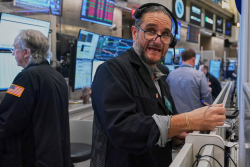
Image via RealClearMarkets (Mark Hulbert / MarketWatch)
Double-Digit Earnings Growth Won’t Save You From a Bear Tape
Mark Hulbert’s point is simple: earnings growth is a lagging comfort blanket in a falling market. In bears, the market doesn’t just re-rate a little—it reprices the whole certainty stack: margins, multiples, and the credibility of forward guidance. Double-digit EPS can coexist with brutal drawdowns when the discount rate is moving against you and investors stop paying up for “visibility.”
The bigger issue is composition. Today’s “strong earnings” are still concentrated in a narrow cohort with pricing power and AI-capex narratives, while the broad market is dealing with slower nominal growth, sticky costs, and the risk that buybacks decelerate as balance sheets get more expensive. Bears don’t need an earnings collapse; they just need the market to decide that E is fine but P/E is fantasy.
📈 Fred's Take: If you’re waiting for earnings to tell you when the bear is over, you’ll buy the top of every dead-cat bounce. Bears end when financial conditions loosen and multiples stop compressing—not when CNBC discovers “resilient profits.” Trade it like a valuation/regime problem: keep duration risk tight, favor quality balance sheets, and don’t chase “good numbers” in a bad tape.
📎 RealClearMarkets (Mark Hulbert / MarketWatch)

Image via TheStreet
T-Mobile’s Leaked Memo: The Next Pricing/Policy Squeeze Hits Wireless
A leaked internal memo suggests T-Mobile is planning a customer-facing policy change that also impacts frontline employees—exact details aside, the shape is familiar: carrier economics are tightening, and management is reaching for levers that lift ARPU and reduce service costs. That means plan restructures, perks trimmed, autopay quirks, upgrade/financing tweaks, or customer-service workflow changes that shift friction onto the user.
Wireless has been “steady” because it’s a subscription utility—until it isn’t. When carriers start fiddling with terms, it’s usually a signal that growth is harder to find and costs (network capex, spectrum, labor, handset subsidies) aren’t cooperating. Backlash matters because churn is the silent killer in telecom: you lose a customer, you lose years of cash flow.
📈 Fred's Take: This reads like margin defense in a saturated market. If they push too hard, churn rises and the market punishes the stock—telecom is priced like a bond with a buyback. Watch churn commentary and any ARPU pop that comes with reputational damage; that’s not bullish, that’s desperation.
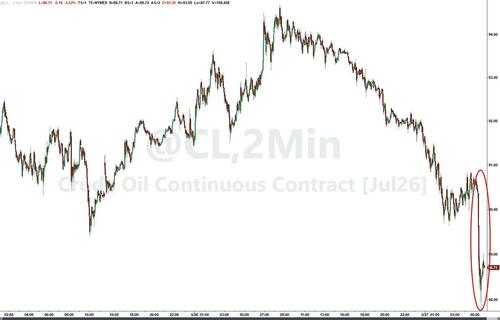
Image via ZeroHedge
Oil Drops as Tehran Floats “Peace Framework,” Ducks Uranium—Markets Smell Supply
Oil tumbling on headlines out of Tehran is the market doing what it always does: pricing the possibility of reduced geopolitical risk and a looser supply outlook before anything is signed. Iran pushing a draft peace framework while sidestepping the uranium question tells you negotiations are still messy—but crude traders trade direction, not morality.
Even a marginal probability of sanctions relief or de-escalation shifts the risk premium. Meanwhile global demand is not exactly ripping; the market is hypersensitive to any narrative that adds barrels. Put it together: crude is vulnerable when the tape is already leaning “soft landing / slower demand / more supply.”
📈 Fred's Take: Don’t confuse headline-driven oil weakness with a clean macro all-clear. Lower crude is a tax cut for consumers and helps disinflation—bullish for duration and rate-sensitive equities—but it also pressures energy earnings and high-yield credit at the margin. If WTI keeps sliding, I’m watching breakevens and the Fed path more than I’m watching Middle East poetry.
Image via Fox Business
Meta Cuts ~1,400 in Washington: AI Overhaul Means More Opex Discipline, Not Less
Meta cutting nearly 1,400 roles across Seattle/Bellevue/Redmond and remote positions is the latest signal that “AI spending” doesn’t mean “AI bloat.” Big Tech is trying to do two things at once: fund massive compute/capex while keeping operating expense growth contained. Layoffs are how they protect margins while they retool the org chart around model development, infra, and productization.
This also hits the regional labor market: high-comp jobs rolling off in Washington feeds into the broader story of tech labor normalizing after the post-COVID hiring binge. For markets, it’s another reminder that the Mag 7-style playbook is: cut headcount, automate workflows, and redirect dollars to data centers.
📈 Fred's Take: This is margin management dressed as transformation—and the market usually rewards it. The near-term winners are Meta’s operating leverage and the “AI supply chain” (compute, networking, power). The losers are the local labor market and any consumer-facing businesses that were counting on tech payrolls to stay frothy.

Image via Bloomberg
Europe Splits on China: Germany Blinks, Markets Price the Export Drag
Bloomberg’s note is about a familiar European problem: everyone wants to “de-risk” from China until the bill shows up. Germany’s economy minister warning about export impacts ahead of a key EU debate tells you the bloc is divided between strategic posture and industrial reality. Germany’s manufacturing base is levered to Chinese demand and supply chains; it can’t pivot on a dime without eating growth.
The market implication is twofold: more policy uncertainty for European multinationals, and a higher chance of piecemeal measures instead of a coherent stance. That keeps risk premia elevated in EU cyclicals and complicates the euro-area growth outlook—especially if global trade slows.
📈 Fred's Take: Europe wants U.S.-style China toughness with a Germany-style trade model. You can’t have both without paying for it in earnings. Until the EU picks a lane, expect headline volatility in autos/industrial exporters and a continued bid for defensives over cyclicals in Europe.
That’s the tape. Stay liquid, stay skeptical, and don’t let headlines manage your risk.
— Fred Frost
