In partnership with

Waiting for the Anthropic IPO? Read this before day one.

Anthropic is public. Trade your view 2x, up or down.
Anthropic is now trading, and so are GraniteShares’ two 2x ETFs on it.
AIL → bullish, seeks 2x Anthropic’s daily move
ANS → bearish, seeks 2x the opposite
Anthropic +1% → AIL seeks +2%
Anthropic −1% → ANS seeks +2%
Built for traders who want to act on a short-term view of Anthropic, up or down, in one ticker, no margin needed.
Now available in your trading apps.
The fund does not invest in the underlying stock. Investment in these funds is not an investment in the underlying stock. Investment in these ETFs involve significant risk and are a short-term trading vehicle. Please go through the Prospectus and risk information before investing. Funds are distributed by ALPS Distributors, Inc. For important risk disclosures, learn more at https://graniteshares.com/

The tape is being yanked around by two forces: AI wealth and geopolitics. One pumps liquidity and risk appetite. The other keeps a bid under energy, defense, and gold even when the consumer gets a break at the pump.
Image via Fox Business
Anthropic’s $1.5T IPO just reloaded Miami money
A $1.5 trillion AI IPO doesn’t just reprice a sector. It rewires cities. You’re about to see the second-order effects: founders, early employees, and allocators turning paper into property, and South Florida is the cleanest funnel in America for that flow.
Developers aren’t guessing. This is the same post-exit migration math we saw after the dot-com era, after the 2020-2021 liquidity boom, and after every big tech monetization event: taxes, weather, proximity to capital, and a culture that doesn’t sneer at money.
In market terms, this is bullish for Florida CRE, private credit tied to development, and high-end consumption names with exposure to the region. It’s also a reminder that “IPO window open” is not a headline, it’s a liquidity event that bleeds into everything from muni bases to luxury inventory.
📈 Fred's Take: A $1.5T print is a neon sign that the AI cycle has become its own macro factor, not a sub-theme inside tech. The wealth effect will be real and it will hit local inflation first: housing, services, insurance, labor. Trade it by staying long the picks-and-shovels around wealthy migration and treating frothy AI beta like a rental, not a marriage.

Image via NBC News
Kyiv bridges hit: war risk premium isn’t leaving your screens
Russian ballistic strikes hitting multiple bridges in Kyiv is escalation by targeting mobility and logistics inside the capital. The timing matters: it follows threats of retaliation tied to Crimea, which means Moscow is signaling it can raise costs when provoked, not just hold lines.
This keeps the European risk premium alive even if the front lines don’t dramatically move. Markets translate this into three buckets: defense spending certainty, energy supply anxiety, and a steady bid for safe collateral whenever headlines cross from “stalemate” to “shock.”
Watch the knock-ons: European industrial confidence, insurance and shipping risk, and any renewed pressure on gas flows that feeds directly into European inflation prints. If you’re waiting for “resolution” to price peace, you’re going to be waiting while the market reprices tail risk in real time.
📈 Fred's Take: This isn’t a one-day headline; it’s a volatility regime. Defense remains a structural long, and every escalation like this hardens the floor under gold and short-dated safe-haven rates. If you’re running a growth-heavy book, you hedge geopolitics with exposure you can actually monetize fast: energy, defense, and a slice of gold, not hand-waving.
📎 NBC News

Image via Washington Examiner
Eagle-Panda-Bear summit theater: markets care about the footnotes
A three-way leaders’ moment on the APEC sidelines is diplomatic choreography with real pricing power. When the U.S., China, and Russia share a stage, the market doesn’t trade the handshakes. It trades the implied boundaries: what gets sanctioned, what gets exempted, and what corridors stay open for chips, capital, and commodities.
The center of gravity here is China policy. Any hint of de-escalation on tech restrictions supports semis and the broader risk complex. Any hint of tightening pushes supply-chain inflation back into the narrative and lifts the dollar on stress.
Russia’s angle is energy and enforcement. Even without new measures, the conversation itself can shift expectations on secondary sanctions, shipping compliance, and how aggressively the U.S. leans on buyers. That’s how you get oil moving on “talks,” not barrels.
📈 Fred's Take: Treat this summit like an options market: you’re paying for tails, not the baseline. If the readout smells like détente, cyclicals and semis pop and the dollar softens; if it’s performative with threats, you get dollar strength and a bid back into energy and gold. Don’t overtrade the speeches, but do respect that policy footnotes move multiples faster than earnings do.
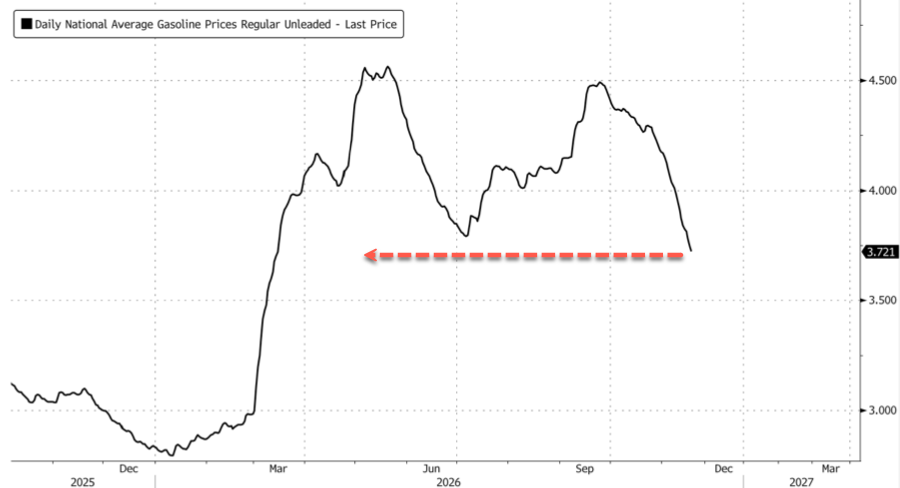
Image via ZeroHedge
Gas at an eight-month low: the cleanest pre-Thanksgiving stimulus
Pump prices rolling to an eight-month low into Thanksgiving is the rare macro gift that hits fast. Lower gasoline is immediate disposable income, and it shows up first in travel behavior, then in card spending, then in sentiment.
This matters for inflation optics too. If energy cooperates, the next CPI cadence looks calmer even if shelter stays sticky. That changes the posture of the Fed narrative at the margin: less urgency to tighten, more permission to wait.
For markets, cheaper gas is not automatically bearish energy equities. Demand tends to rise into holiday travel, and crude doesn’t trade off your local station sign. The bigger trade is consumer rotation: travel, restaurants, and value retail get air cover when the weekly fuel bill drops.
📈 Fred's Take: Lower pump prices is a stealth cut in the tax you actually feel, and it supports Q4 consumption even if wage growth cools. I’d use it to stay constructive on consumer names with pricing power and real traffic, while keeping energy exposure selective and quality-focused. The Fed doesn’t need perfection; it needs inflation momentum, and gas helps the headline math.
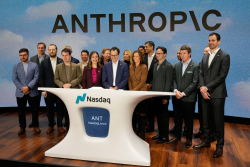
Image via RealClearMarkets
IPO euphoria meets Fed patience: that mix can levitate markets
The cheerleading around a blockbuster AI IPO is doing two jobs at once: it signals risk appetite and it reopens the capital-markets pipeline. When IPOs work, bankers dust off calendars, VC marks stabilize, and the wealth effect pushes back into public equities through flows.
At the same time, the applause for Fed caution is the other leg of the stool. “Caution” is code for not breaking something unnecessarily. If the market believes the Fed will protect disinflation progress without crushing growth, multiples expand and duration trades better.
The tension is obvious: easy financial conditions can re-ignite the very inflation the Fed is trying to bury. The market’s sweet spot is a Goldilocks glide path. The Fed’s job is to prevent the crowd from turning that glide path into a party.
📈 Fred's Take: This is the recipe for a melt-up: strong equity issuance plus a central bank that’s willing to sit on its hands. The risk is that IPO heat loosens conditions so much that the Fed has to re-tighten later, which is how you get a sharp drawdown after a euphoric tape. Trade the momentum, but keep a risk switch: when the IPO calendar gets stupid, start taking profits and rotate to balance-sheet quality.
That’s the setup into the open: AI liquidity on one side, war premium on the other, and the consumer catching a break at the pump. Trade what pays, hedge what kills.
— Fred Frost

