Today’s Sponsor
Mode Mobile — the company ranked North America's #1 fastest-growing software company by Deloitte with 32,481% growth — is still offering pre-IPO shares at $0.52/share. But not for long. On August 14, the price goes up. With 490M+ users, $115M+ in lifetime revenue, and a reserved Nasdaq ticker ($MODE), over 60,000 investors have already poured in $100M+ — including original Shark Tank investor Kevin Harrington.
This is your last shot at the current entry point. Just like Uber disrupted cars and Airbnb disrupted homes, Mode is turning everyday phone use into income — and the window to get in early is closing fast. Don't miss the August 14 deadline.
Claim Your Pre-IPO Shares Now*Mode Mobile recently received their ticker reservation with Nasdaq ($MODE), indicating an intent to IPO in the next 24 months. An intent to IPO is no guarantee that an actual IPO will occur. *The Deloitte rankings are based on submitted applications and public company database research, with winners selected based on their fiscal-year revenue growth percentage over a three-year period. *Mode revenue and EBITDA numbers include full year revenue and EBITDA of businesses acquired by Mode Mobile in 2025. *Please read the offering circular and related risks at invest.modemobile.com.

Monday, August 10, 2026 | The Crossroads of Politics & Investing
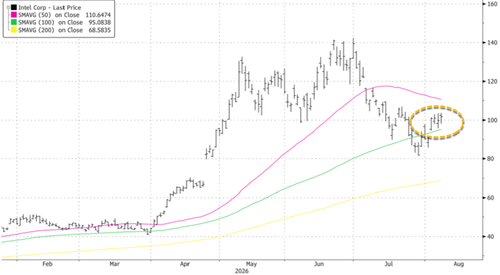
Image via ZeroHedge
Intel Prints $15B Of Equity: The AI Boom Just Got Real Expensive
Intel is selling $15 billion in stock to fund its AI buildout. That’s the tell: the era of "fund it with cheap debt and vibes" is over. When capex runs toward the trillion-dollar neighborhood, even the big boys start reaching for equity.
This is dilution, but it’s also survival math. Foundry, packaging, accelerators, networking, power and cooling, and the software stack all demand upfront spend, and the payback window is longer than Wall Street’s attention span. If your balance sheet can’t carry it, you issue stock.
Zoom out: this is what late-cycle capex booms look like. The winners finance early at reasonable terms. The rest finance late, with higher rates, tighter credit, and more shareholders at the table.
📈 Fred's Take: This is bearish for Intel near-term and mildly bullish for the AI complex long-term because it confirms the spending isn’t slowing, it’s getting financed more aggressively. Expect more equity raises across second-tier AI infrastructure names, and expect investors to start penalizing the "capex with no cash flow" cohort harder. If you own AI beneficiaries, own the toll collectors with pricing power and margins, not the ones buying revenue with dilution.
Trump Signals Economic Squeeze On Iran As Hormuz Stays Choked
Trump is signaling a shift toward economic pressure as Iran hardens its stance and the Strait of Hormuz remains clogged after months of disruption. Markets have had time to normalize the headline risk, but not the physical risk: freight, insurance, routing, and delivery schedules stay ugly when the choke point stays partially shut.
The longer this drags, the more it bleeds into inflation optics. Energy isn’t just gasoline; it’s petrochemicals, shipping, and input costs that flow into CPI and corporate margins with a lag. Central banks may talk tough, but geopolitics can force their hand by reintroducing a supply-side price shock.
Economic pressure also means secondary effects: sanctions enforcement, shipping seizures, and a compliance tax on global trade. That’s a stealth tightening that rarely shows up in policy statements but shows up fast in risk premia.
📈 Fred's Take: This is a risk-premium story, not a one-day spike story. Stay long some form of energy convexity (quality producers, disciplined refiners, or options) and don’t fight higher breakevens if the choke persists. The equity market can levitate until margins roll over; watch transports, chemicals, and consumer discretionary for the first real tells.
📎 CNBC
Image via Fox Business
Zuck Wants Superintelligence For Everyone: Translation, He Wants The Platform To Own The Edge
Mark Zuckerberg is laying out a vision to put superintelligent AI in everyone’s hands, arguing that concentrated AI power is a threat to individual empowerment. In practice, this is a positioning statement in the real war: distribution. Models matter, but distribution decides who captures the profit pool.
Meta’s pitch is broad access and open(ish) tooling, which pressures closed ecosystems and forces a price conversation. If AI becomes embedded in consumer experiences at scale, the winner isn’t the fanciest demo, it’s the default assistant living inside the apps people already use all day.
There’s a second layer: regulation. "Democratize" is also a shield against antitrust heat and a wedge against rivals framed as gatekeepers. Expect more rhetoric about openness as policymakers circle AI concentration risk.
📈 Fred's Take: This is bullish for Meta’s engagement flywheel and bearish for anyone whose moat is "we charge a lot per token." The market is moving toward AI as a feature, not a product, which compresses standalone model margins and shifts value to data, distribution, and hardware adjacency. If you’re investing, stop paying peak multiples for model-only stories and start paying for ecosystems that can bundle and cross-subsidize.

Image via NTD
South China Sea Spat: Washington Shrugs Off Beijing, Markets Should Price The Supply Chain Tail
The U.S. rejected China’s claims that American actions are destabilizing the South China Sea. This is the familiar script: dueling statements, increased patrols, and a steady grind of confrontation risk around shipping lanes and strategic chokepoints.
Investors tend to ignore it until it’s too late because the timeline is unknowable. But the market impact is very knowable when friction rises: higher shipping costs, more inventory buffering, and more capex devoted to redundancy. That is inflationary at the margin and negative for companies that rely on just-in-time logistics.
It also reinforces the ongoing industrial policy cycle. Defense, shipbuilding, aerospace, and critical supply chain onshoring don’t need a shooting war to keep winning; they just need persistent uncertainty.
📈 Fred's Take: This is a slow-burn tail risk that keeps a floor under defense and keeps a ceiling on globalization multiples. Own the beneficiaries of redundancy: defense primes, select logistics with pricing power, and domestic industrial enablers. If you’re still modeling a frictionless Asia supply chain, you’re modeling 2017, not 2026.
📎 NTD

Image via Yahoo Finance
JNJ’s Ottava Gets FDA Nod: The Robot Wars Finally Have A Second Serious Player
Johnson & Johnson’s Ottava has FDA approval, raising the obvious question: can JNJ challenge Intuitive Surgical’s dominance in robotic surgery? The approval matters because it turns Ottava from a science project into a commercial execution story, where service networks, surgeon training, and hospital procurement decide adoption.
Intuitive’s moat has always been workflow and installed base, not just the robot. Hospitals buy an ecosystem: instruments, software, uptime, and predictable economics. For JNJ, the play is to leverage existing hospital relationships and bundle across devices and consumables, potentially changing pricing dynamics in a market that’s been comfortably monopolistic.
Competition should also accelerate innovation cadence. More systems in the field means more data, more software updates, and more pressure to prove better outcomes and lower total procedure cost.
📈 Fred's Take: JNJ’s approval is the first real threat to ISRG’s pricing power in years, but share shift will be slow and brutally operational. Near-term, this is more risk to ISRG’s multiple than to its revenues; hospitals don’t rip out fleets overnight. Longer-term, if JNJ uses bundling to compress per-procedure economics, the whole robotic surgery space trades more like medtech (good business) and less like a monopoly toll booth (great multiple).
That’s the board. Trade the financing mix in AI, respect the war premium in energy, and don’t sleep on robotics turning into a pricing fight.
— Fred Frost
